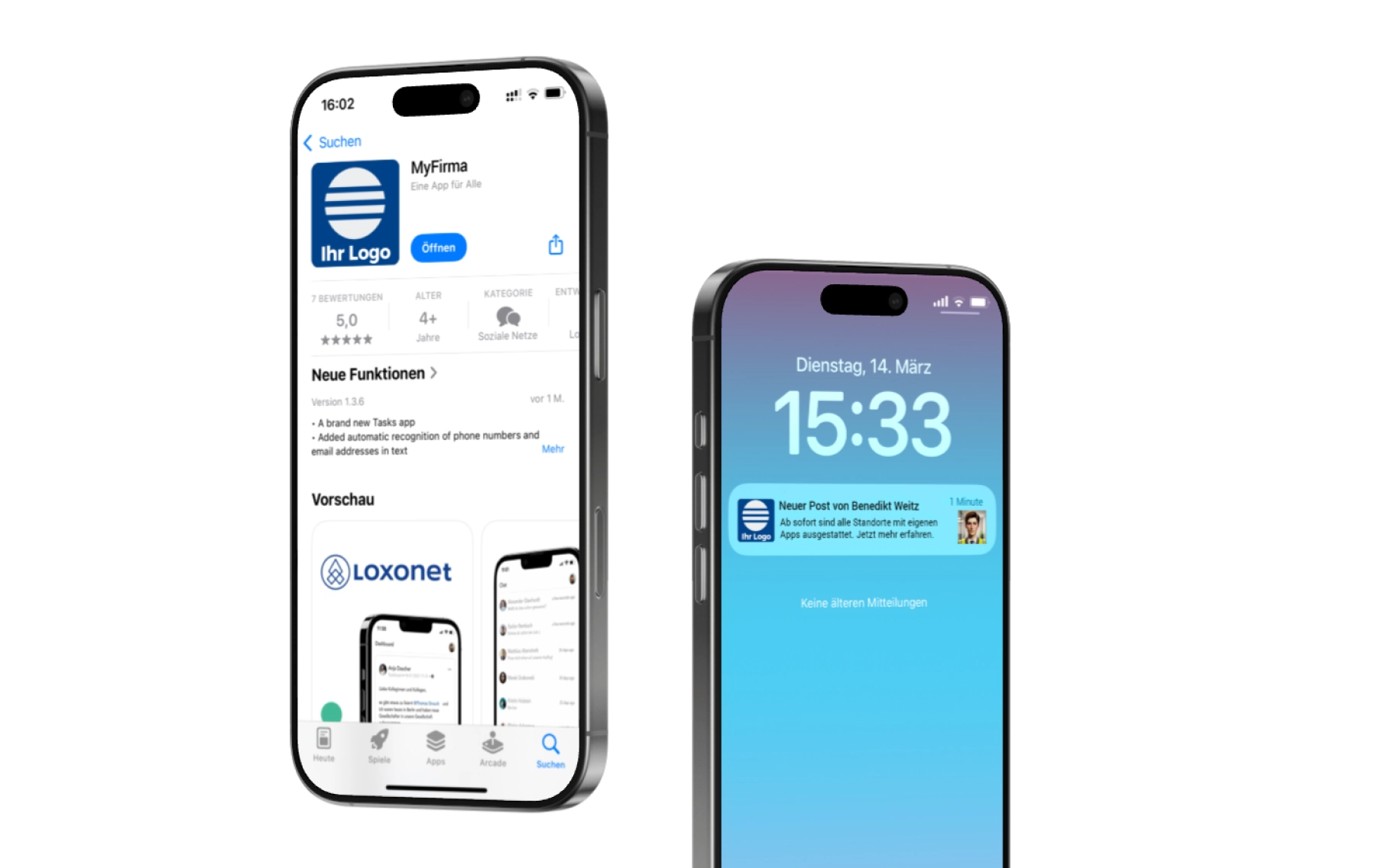
Apps for corporate communication: Already the new standard in internal communication?

Internal corporate communication has changed dramatically in recent years. While traditional channels such as email, intranet, and face-to-face meetings continue to be used, mobile communication platforms are gaining increasing importance. Employee apps are being used in many organizations as a key supplement to, or even the primary channel for, internal information.
However, whether they can already be considered a new standard depends heavily on company size, industry and level of digitalization.
Evolution of the internal communication landscape:
Traditional internal communication was long dominated by linear channels:
- Email distribution list for information
- Static intranets as information storage
- Notices at physical locations
- Regular meetings as the main exchange format
These structures are functional, but they reach their limits in increasingly distributed and dynamic work environments. In particular, speed, reach, and transparency are limited in traditional models.
Why mobile communication is gaining importance:
The increasing use of mobile devices in everyday work has changed the requirements for internal communication. Employees now expect information to be:
- are available promptly
- are accessible regardless of location
- be clearly structured and presented in a relevant manner
- can be accessed without media breaks
Employee apps address these requirements through centralized, mobile information availability and structured communication.
Operating principle of modern communication apps:
Employee apps combine various communication and information functions into a single platform. Typical components include:
- Real-time company news
- Target group-specific information distribution
- Commenting and feedback functions
- Document and policy access
- Notifications about important events
These functions reduce the dependence on multiple parallel communication channels.
Comparison to traditional communication channels
: Compared to email and intranet, employee apps differ particularly in the following aspects:
- higher mobile usage
- stronger push communication instead of a pull principle
- better target group management
- faster information distribution
- increased transparency regarding reach
Email remains an important channel, especially for external communication and formal processes, but is increasingly being supplemented internally by structured platforms.
Role in hybrid and decentralized work models:
The spread of hybrid work models has further increased the demands on internal communication. Employees are working more frequently:
- remote or mobile
- in shift systems
- at several locations
- in project-based teams
In such structures, access to consistent information becomes more difficult. Employee apps create a central interface that functions regardless of location or time.
The Importance of Real-Time Communication:
A key advantage of modern communication platforms lies in the speed of information distribution. Unlike traditional channels, apps enable:
- Immediate release of updates
- direct notification of relevant target groups
- short-term adjustments to information
- reduced communication delays
This is particularly relevant in highly dynamic situations, such as organizational changes or operational instructions.
Impact on Information Equality within the Company:
A common problem with traditional communication structures is the uneven distribution of information. Not all employees receive content at the same time or via the same channel.
Employee apps contribute to standardization by:
- Create central information sources
- provide consistent content for all users
- Enable access regardless of hierarchy or location
This reduces the likelihood of relevant information arriving late or incomplete.
Limitations and Challenges
Despite their advantages, employee apps are not a complete replacement for existing communication channels. Typical challenges include:
- parallel use of multiple systems
- Requirements for continuous content maintenance
- necessary organizational adjustments
- Different levels of acceptance within workforces
Success therefore depends less on the technology itself than on its integration into existing communication processes.
Not a complete replacement, but an extension:
Current developments show that employee apps are not used in isolation in most organizations, but rather function as part of a communication mix. They complement existing systems and take on functions particularly where speed, mobility, and target group management are crucial.
In conclusion,
employee apps have become a central component of internal communication in many companies. They offer advantages in terms of reach, speed, and information structuring, and are particularly well-suited to hybrid and decentralized work models.
Whether they can already be considered a "new standard" depends on the specific organizational context. However, in many companies they are already an integral part of modern communication architectures and are increasingly developing into a central platform for internal information distribution.