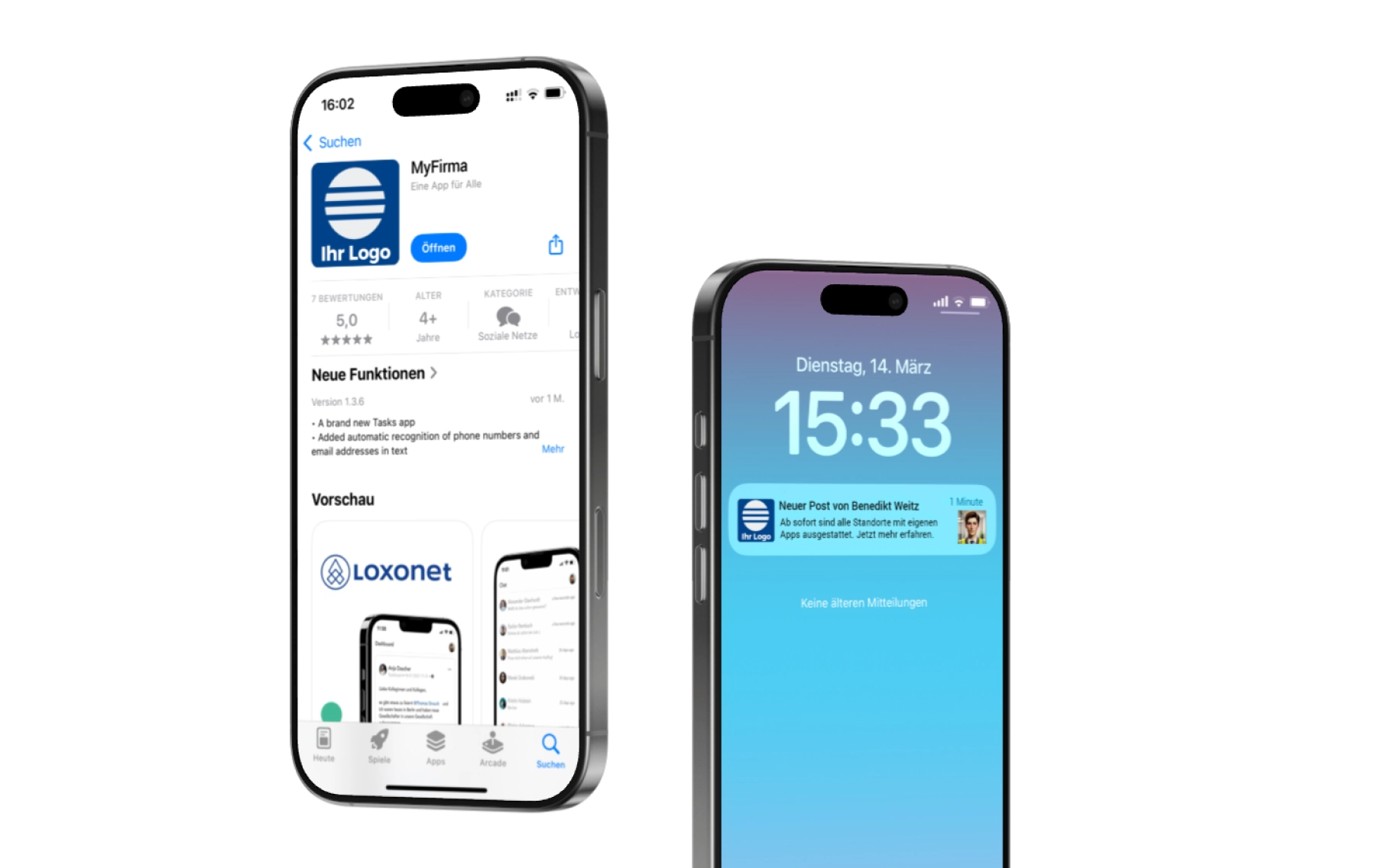
The difference between using an employee app in a large corporation vs. a medium-sized company

Employee apps are used in companies of varying sizes to digitize internal communication, processes, and collaboration. Although the underlying technology may be identical, requirements, implementation strategies, and usage patterns differ significantly between large corporations and medium-sized businesses.
These differences arise less from the software itself, but rather from organizational structure, communication channels, and decision-making processes.
Organizational structure as a key influencing factor:
The structure of a company significantly determines how an employee app is used.
The following are typically present in corporations:
- multiple hierarchy levels
- international locations
- highly segmented specialist areas
- central and local communications departments
In contrast, the following are frequently found in medium-sized businesses:
- flatter hierarchies
- shorter decision-making processes
- more centralized communication
- lower organizational complexity
These structural differences directly affect the app's content, governance, and management.
Communication complexity and reach:
In corporations, internal communication is often organized in multiple stages. Information is created centrally, adapted locally, and then distributed. This leads to greater complexity in coordination and approval processes.
Typical characteristics in the corporate environment:
- multilingual content
- Location-specific communication needs
- tiered information releases
- high number of internal target groups
In medium-sized businesses, communication is generally more direct. Content is often created centrally and distributed to all employees without major adjustments.
This leads to:
- reduced translation and segmentation requirements
- faster release cycles
- clearer communication channels
Implementation strategy and rollout:
The introduction of an employee app also differs significantly.
Within the group, the rollout is frequently carried out:
- step by step, according to regions or subsidiaries
- with extensive pilot phases
- accompanied by change management programs
- involving multiple stakeholders
In medium-sized businesses, the rollout is usually:
- centrally controlled
- implemented more quickly
- less formalized
- more practically oriented
The reduced coordination effort allows for a faster technical and organizational implementation.
Analyzing participation and interaction:
A modern employee app is not solely for distributing information, but ideally promotes dialogue between the company and its workforce.
Measurable indicators of this are:
- Number of comments
- Likes or reactions
- Survey participation
- submitted ideas or feedback
- Participation in discussions
A high interaction rate often indicates an active corporate culture and shows that employees not only consume the platform, but actively use it.
Governance and control of the platform's
corporate structures generally require a more pronounced governance model. This includes:
- defined editorial guidelines
- Content approval processes
- Role and rights concepts at multiple levels
- Compliance requirements, especially for international companies
In medium-sized businesses, these structures are often leaner:
- less formalized approval processes
- smaller editorial teams
- stronger operational control
- direct access to content by those responsible
These differences affect the speed and flexibility of communication.
Functional use and use cases:
The main areas of use for an employee app also vary between the two types of companies.
Within the group, the following are often the main focus:
- Group-wide corporate communications
- internal campaigns and change communication
- Cross-site collaboration
- HR communication in several countries
- structured knowledge distribution
In medium-sized businesses, operational use cases tend to be more prevalent:
- internal communication in day-to-day business
- digital processes such as vacation requests or document distribution
- Rapid dissemination of information to all employees
- Support for leadership communication
The app is frequently used in medium-sized businesses as a direct component of operational processes.
Technical Integration and System Landscape:
Corporate environments typically have complex IT landscapes with numerous integrated systems. An employee app often needs to be connected to existing platforms, such as:
- HR systems
- Identity management solutions
- Intranet structures
- Learning Management Systems
In medium-sized businesses, the system landscape is often simpler. This leads to:
- lower integration complexity
- faster implementation
- fewer interface requirements
At the same time, the selection of existing systems may be more limited, which means that the employee app often takes on a central role as a communication platform.
Acceptance and usage patterns:
Usage patterns also differ between corporations and medium-sized businesses.
In large corporations, user acceptance is often more dependent on:
- local relevance of the content
- linguistic and cultural adaptation
- Involvement of managers at the site level
In medium-sized businesses, other factors play a role:
- Immediate benefits in everyday work
- easy operation
- direct relevance for operational processes
- personal proximity to company management
The smaller organizational distance often leads to faster feedback cycles.
Success measurement and control:
Success is measured in both types of companies based on similar KPIs, but differs in interpretation.
The following are frequently analyzed within the group:
- Location-based usage data
- Segmentation by target group
- international comparability of key figures
In medium-sized businesses, the focus is more on:
- Overall utilization rate
- Process digitization
- Efficiency gains in day-to-day operations
- Employee satisfaction
The lower data complexity in medium-sized businesses often allows for a more direct derivation of measures.
Conclusion:
The use of an employee app is significantly influenced by company size and structure. While complexity, governance, and segmentation are key factors in large corporations, speed, direct communication, and operational use are paramount in medium-sized businesses.
Both approaches pursue the same goal, but differ significantly in implementation, management, and areas of application. A successful concept consistently takes these structural differences into account and adapts its implementation and communication strategies accordingly.