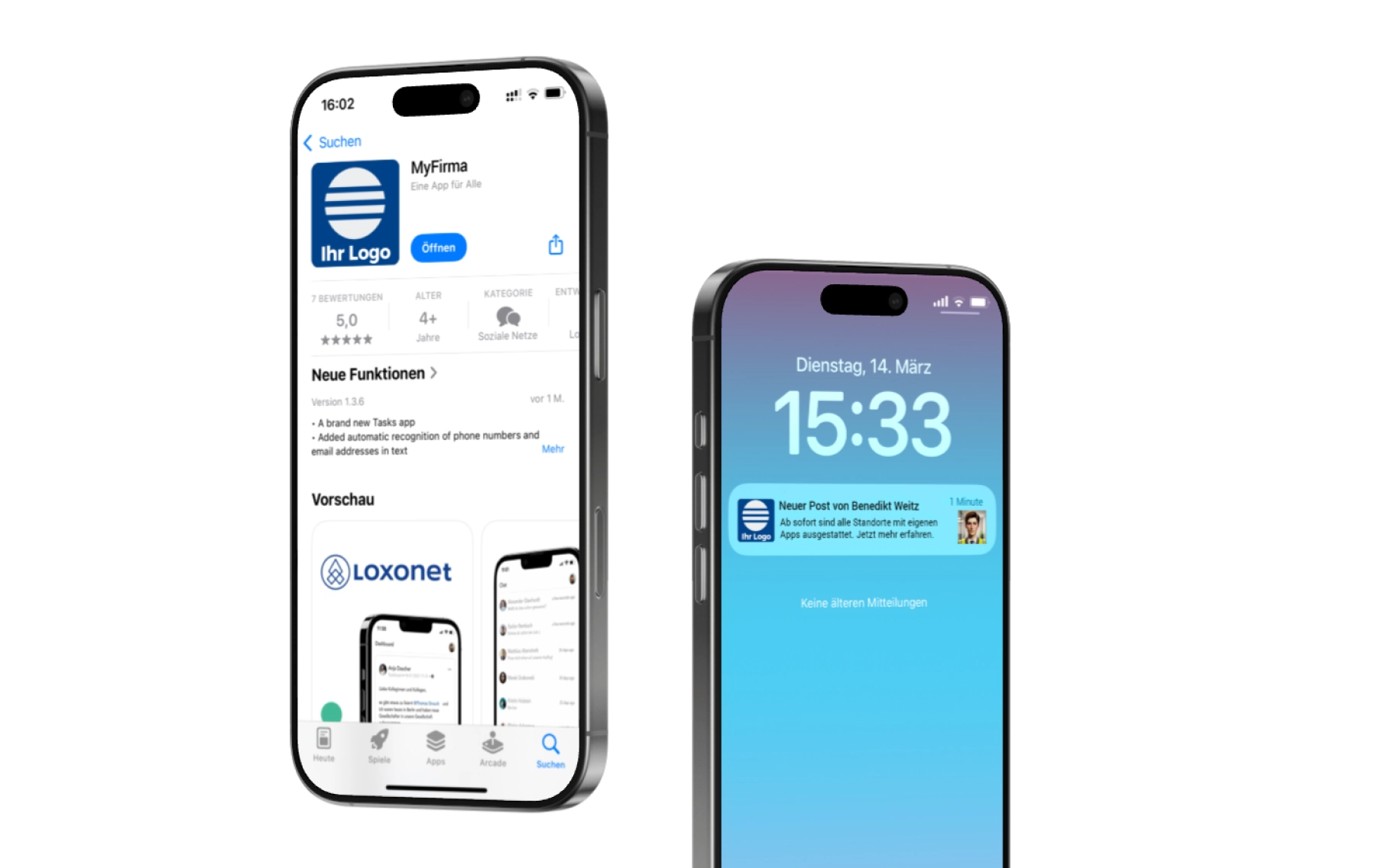
Modern solutions for traditional challenges: The use of employee apps in conservative companies

Conservative companies are often characterized by stable structures, established processes, and long-standing communication channels. This stability offers advantages in terms of reliability and quality assurance, but in many cases also leads to less adaptability to digital changes.
Employee apps are increasingly being used as a tool to combine traditional organizational forms with modern communication and process requirements without completely replacing existing structures.
Characteristics of conservative corporate structures:
Conservative companies can often be described by certain organizational characteristics:
- highly hierarchical decision-making processes
- formalized communication processes
- High importance of written documentation
- established, often analog process landscapes
- cautious introduction of new technologies
These properties lead to high process reliability, but can limit the speed of internal communication.
Challenges of traditional communication structures:
In traditional organizations, internal communication often takes place via multiple channels simultaneously, including email, notices, meetings, and intranet systems. This diversity can lead to the following challenges:
- Information loss due to media breaks
- Delayed distribution of updates
- Limited mobile availability of information
- Low transparency regarding communication reach
- redundant information processing
This increases the coordination effort, especially in larger or multi-site organizations.
Role of the employee app as a supplementary communication layer:
Employee apps do not usually completely replace existing systems, but rather supplement them with a central, mobile access layer.
Typical functions in an organizational context include:
- central provision of company information
- structured distribution of messages
- role-based or target group-specific communication
- Mobile availability regardless of workplace
- Consistent display of content across all devices
This creates an additional communication layer between operational processes and existing IT systems.
Support in the digitization of existing processes.
A key area of application in conservative companies is the gradual digitization of existing paper-based or manual processes.
Examples include:
- Digital leave and absence requests
- electronic forms for internal processes
- digital payroll and document provision
- structured feedback processes
- central repository of guidelines and documents
This gradual digitization enables a controlled transformation without complete system disruptions.
Improving internal information availability:
A central problem of classical structures is the delayed or incomplete availability of information.
Employee apps address this aspect by:
- immediate release of information
- Uniform information levels for all employees
- Search functions for historical content
- Push notifications for relevant updates
- reduced dependence on physical or location-based media
This particularly improves information equality within distributed organizations.
Changing communication patterns without structural disruption:
Conservative companies often face the challenge of introducing digital solutions without destabilizing existing structures.
Employee apps enable evolutionary change in this context:
- Existing communication channels will be maintained.
- Digital channels will be introduced as a supplement.
- The rollout will be gradual rather than disruptive.
- Adaptation to existing role and hierarchy structures
This lowers the barrier to entry for organizational changes.
Importance of acceptance and leadership communication:
The introduction of digital tools in conservative organizations is heavily dependent on acceptance at the leadership level.
Factors influencing usage include:
- active use by managers
- clear communication of the intended use
- Integration into existing work processes
- demonstrable practical benefits in everyday life
In particular, the exemplary role of management levels plays a central role in sustainable use.
Structured implementation as a success factor:
The introduction of an employee app in conservative companies usually takes place gradually to ensure organizational stability.
Typical phases are:
- Pilot project in selected areas
- iterative expansion to other departments
- Adaptation of communication guidelines
- continuous training and support of users
This step-by-step approach reduces risks and increases the predictability of the implementation.
Limitations and requirements:
The successful use of an employee app requires certain framework conditions:
- defined responsibilities for content
- clear regulations for information management
- Integration into existing processes
- regular updates of the content
Without these organizational prerequisites, the technical solution can only have a limited effect.
Conclusion:
In conservative companies, the introduction of digital communication and process solutions presents a particular challenge, as existing structures are stable and have evolved over the long term. Employee apps offer an approach here that does not aim to replace existing systems, but rather to complement and gradually develop them further.
Through centralized information availability, mobile usage options and structured process digitization, traditional organizational forms can be modernized without losing their fundamental stability.